How to Trade Meme Coins With a $10 Portfolio in 2026 Without Fees Eating the Gains
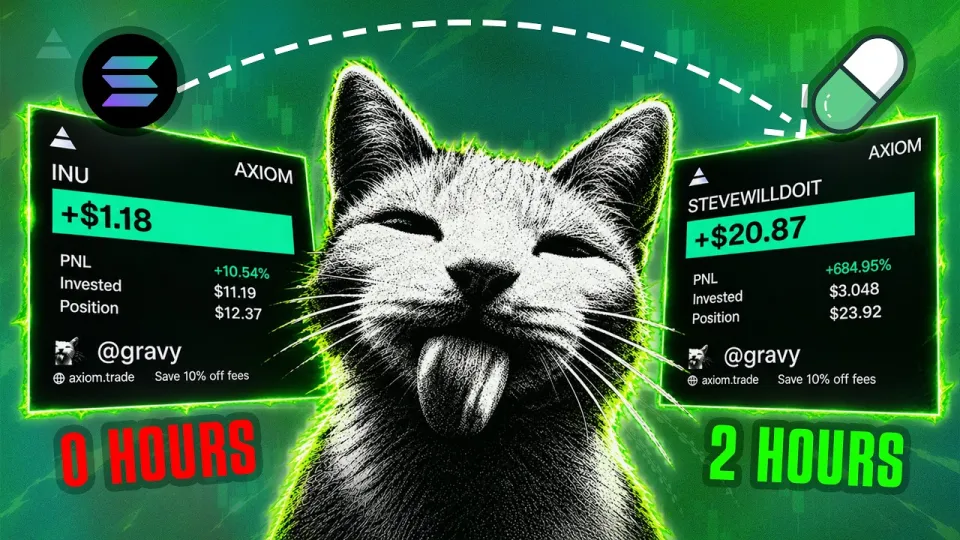
Video: I Tried Trading Memecoins with Just $10
Need articles like this for your video? They help promote it on YouTube and Google — order them in the Telegram bot @sat_sit_bot. Articles with your video embedded are written and posted by the bot itself — on popular topical sites (no ads). Your first 50 articles are free.
· based on the channel gravy
Key takeaways
- Five real trades on Solana, each buy capped at 0.05 SOL — roughly the size a $10–$20 account can actually fund.
- Coins covered: STEVEWILLDOIT, NPC, MET (Meteora), PUMPY the Trader and UNTXD.
- Fees on Solana swaps are small in absolute terms, but a 1% round-trip on a $10 position is still 10 cents per in-and-out.
- Narrative, not chart patterns, drove every entry: X Money meta, e/acc and AI-adjacent tickers.
- The recurring failure mode for small accounts is selling a 20–40% loss right before the coin runs.
You can trade meme coins with $10, but only if you treat position size and fees as the strategy rather than an afterthought. A $10 account on Solana can fund several 0.05 SOL entries, and the real constraint is not the fee schedule but the number of shots you get and how fast you take a loss. The experiment below follows five small buys routed through Axiom's trading terminal, the setup used in the gravy channel's $10 challenge.
What a $10 meme coin account actually buys you
A $10 account is a bet-sizing problem before it is a picking problem. On Solana, a swap costs a fraction of a cent in network fees plus the venue or aggregator cut, so the absolute cost of a round trip on a 0.05 SOL position is trivial. What is not trivial is the percentage: pay 1% in and 1% out and you need a 2% move just to break even, which on a coin that swings 30% in a minute is noise — but on a slow mover it is a real drag.
The practical rules that fall out of that arithmetic:
- Cap each buy at a fixed fraction of the account — 0.05 SOL per entry keeps five shots alive on a small balance.
- Never average down more than once; a $10 account cannot survive a three-leg ladder into a dead chart.
- Take partials on the first vertical leg instead of waiting for a round number.
- Count fees per trade, not per month, so a string of small losses stays visible.
Why narrative beats technicals on micro-cap launches
Meme coin prices on launchpads are driven by attention, and attention has a source you can name. The coins in this experiment were chosen because a specific story was circulating: a ticker tied to a public figure's payments product, an AI-adjacent "e/acc" theme, a launchpad token, a trader-persona joke, and a ticker built around a viral reply. None of them had a chart worth reading before the first hour of trading.
The work is therefore research, not indicators: who is posting about the ticker, how old the account is, whether the liquidity is locked, and whether the story has already been covered by large accounts. A narrative that is three days old is a different trade from one that is three hours old, and the second one is where small accounts get their edge because they can enter and exit without moving price.
The five trades and what each one taught
Each of the five positions in the challenge was capped at 0.05 SOL, and the interesting part is the reasoning behind entry and exit rather than the PnL. STEVEWILLDOIT was a bet on a viral persona ticker; NPC followed the AI-agent theme; MET was a play on Meteora as a launchpad-adjacent name; PUMPY the Trader leaned on the pump.fun ecosystem's own culture; UNTXD was the trade that got fumbled — entered late, held too long, and exited on emotion rather than on the original thesis.
The pattern across the set: the winners were the trades where the exit was decided before the buy, and the loser was the one where the story changed mid-trade and the position was held anyway. That single asymmetry explains most small-account outcomes, and it is why the channel's own review flagged the missed total-PnL summary as the one gap in an otherwise clean breakdown.
Sizing, slippage and the fee math nobody runs
Slippage is the hidden tax on small meme coin trades, and it is larger than the platform fee. A 0.05 SOL buy into a thin pool can fill 3–8% above the quoted price, which means the position is underwater before the chart even prints. Setting a slippage cap and walking away when the fill is worse than the cap is a discipline worth more than any entry signal.
Fees stack in three layers: network fee, venue or aggregator fee, and priority fee when the chain is busy. On a $10 account the first two are cents, but priority fees spike during exactly the moments when a meme coin is moving fastest, so the effective cost of a fast entry is highest when the opportunity looks best. Referral and cashback programs — the terminal linked above advertises reduced fees and cashback on trades — shift that math slightly in the trader's favor, but they do not fix bad sizing.
Common questions from small-balance traders
The most frequent doubt is whether a small account can compound at all, and the honest answer is that it compounds in shots, not in dollars. A trader who turns $10 into $14 has not made money in any meaningful sense, but has proven a process that scales to $1,000 — which is the actual point of running the experiment on a tiny balance.
The second recurring theme is narrative fatigue: too many tweets, too many tickers, no memory of who matters in which community. The fix is a short watchlist of accounts per sector and a rule that a coin must be mentioned by at least two independent sources before it gets a 0.05 SOL entry. The third is the exit problem — selling a 20–40% loss and then watching the coin run higher. That is usually a symptom of entering without a defined invalidation level, so the stop and the target get improvised under pressure.
Useful links
- Trading terminal used in the challenge (reduced fees and cashback): https://axiom.trade/@gravy
- The Trenches Discord: https://discord.gg/W7TqkExcSd
- Free Axiom imports and trade signals community: https://discord.gg/9W5j3XUgYB
- Author's X account: https://x.com/gravyski
- Futures trading with reduced fees: https://www.bitbase.com/landing-page/trading-earning-Gra?ref=8CYOGY
What the $10 experiment proves about meme coin trading
The takeaway is that a $10 balance is a process test, not a profit engine: five 0.05 SOL trades on Solana are enough to learn sizing, slippage and exit discipline without risking real capital. The five-trade run from the gravy channel shows that narrative selection and pre-planned exits matter far more than the fee schedule everyone blames, and that the one fumbled trade cost more than all the fees combined. Anyone repeating the experiment should log every fill, including the bad ones, and compare the total PnL against the account's starting value. If the process holds at $10, it holds at $1,000 — and if it does not, the loss is a rounding error. Start with a registration on Axiom and paper the rules before funding anything larger.
Questions & answers
Can you really trade meme coins with only $10?
Yes, on Solana the network and venue fees on a 0.05 SOL trade are cents, so a $10 balance can fund several entries. The limit is the number of shots and the slippage on thin pools, not the fee schedule itself.
How much of a small account should go into one meme coin?
A fixed fraction, typically 0.05 SOL per entry on a small balance, so that five or more attempts stay possible after a loss. Averaging down more than once on a $10 account usually ends the experiment early.
Why do small traders sell losses right before the coin runs?
Because the exit was never defined before the buy. Without a pre-set invalidation level, the stop gets improvised during a drawdown, and the trader exits on emotion at exactly the point where the original thesis is still intact.
Do referral links and cashback actually matter for small trades?
They reduce cost at the margin — lower fees and cashback shift a few tenths of a percent per round trip. That helps, but correct position sizing and slippage control save far more than any referral discount.
Source: I Tried Trading Memecoins with Just $10 · Markdown version